
Back in West Lafayette: Talking Indiana Wine at Purdue Wine Appreciation


Some rooms never stop making you nervous. For me, it's the Class of 1950 Lecture Hall at Purdue. It's where I took freshman chemistry, and every time I walk through those doors, some part of my brain still thinks there's an exam I forgot to study for.
So naturally, I keep coming back.
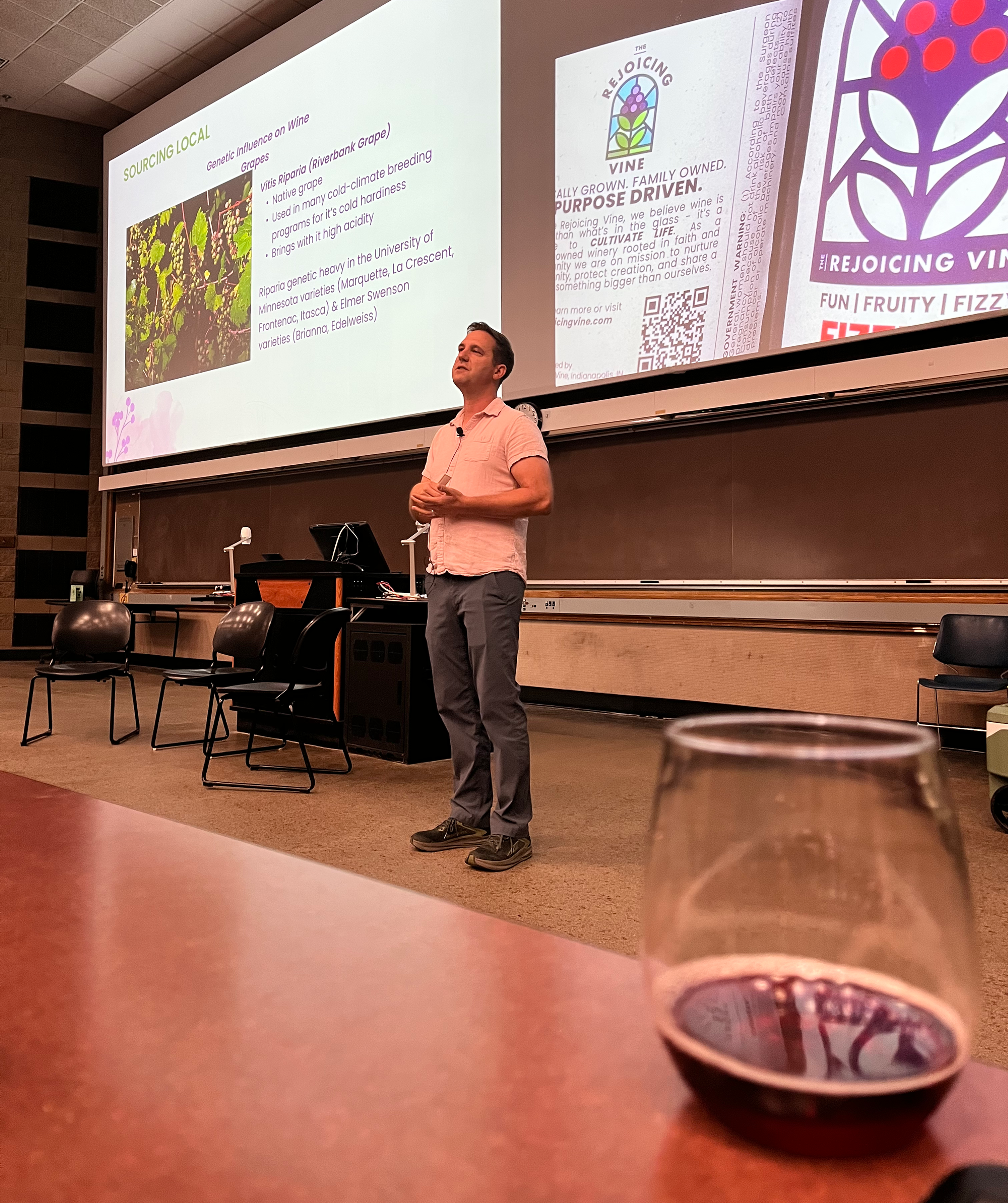
On Monday (10/5), I returned to West Lafayette as a guest speaker for Purdue's Wine Appreciation course, taught by Professor Christian Butzke. It was my second time speaking to the class (you can read about my first visit two years ago here), and this time the whole session centered on something close to my heart: Indiana wine.
A quick fun fact before we go further: I graduated from Purdue in 2005 with a BSEE and a minor in Physics. Boiler Up. 🚂 And an unsobering fact dawned on me as I spoke to the class, my diploma is old enough to drink. GULP... Where do the years go????
...my diploma is old enough to drink. GULP...
Why Indiana Fruit Makes Perfect Sparkling Wine
I started with a little background on me and how an engineer ended up running a winery. Then I introduced the class to The Rejoicing Vine: a converted orchid nursery in northwest Indianapolis near Zionsville, with a 2-acre vineyard and a 16-acre regenerative farm. We opened our doors in June 2023, with a tasting room built around one simple idea: Cultivate Life.
From there, I spent most of my time on one big idea: Indiana fruit and sparkling wine are a natural match.
It comes down to climate. As grapes ripen on the vine, they go from super tart to super sweet. As sugar climbs, their acidity drops, and their tannins and body build. In warm regions with long growing seasons, like much of California, grapes ripen fully and make big, bold, high-alcohol wines. In cooler regions with shorter growing seasons, grapes don't ripen as far. That leaves them higher in acid and lower in sugar, tannin and body. Northern Indiana gets only about 150 to 160 frost-free days a year, according to Purdue Extension's guide to grape varieties for Indiana. That's a short runway for ripening. Compare that to Napa Valley, which can count on roughly 277 frost-free days in 9 out of 10 years, according to University of California data. That's nearly four extra months for grapes to ripen.
Researchers have documented this effect for decades. Warmer temperatures speed up how fast grapes burn through malic acid as they ripen, which is why cool-climate grapes consistently hold onto more of it (Frontiers in Plant Science, 2024).
That cool-climate profile is exactly what sparkling wine wants. Sparkling wine typically made with lower alcohol (lower sugar in the grapes), bright acidity, and very little tannin. And the most famous sparkling wine region in the world, Champagne, is a cool climate too. It's one of the reasons we believe our local fruit doesn't need to imitate Napa. It's built for bubbles.
There's a bonus: carbonation also softens how we perceive acidity. Bright, high-acid fruit can taste fresh and balanced as a sparkling wine with far less added sugar than it would need as a still wine. (For the full breakdown, check out Dry Indiana Wine vs. Your Latte.)
Then came the best part of any wine lecture: tasting. We poured the class our Let's Get Fizzical, a semi-sweet red bubbly made from Concord grapes. Concord is an American grape descended from the "fox grape" or Vitis labrusca, which is native to the eastern United States. Purdue Extension lists it as best suited to the northern half of Indiana. In warmer climates, it can actually struggle to ripen evenly. Purdue also notes that wines from American grapes like Concord are traditionally finished with some sweetness to balance their bold, grapey flavor (Grape Varieties for Indiana). That's exactly why Fizzical is semi-sweet.
Sharing the Stage with Wildcat Creek Winery
I wasn't the only Indiana winemaker in the room. Nyssa Craton, owner of Wildcat Creek Winery in Lafayette and fellow Boiler Alum, joined me and gave her own talk on her winery, some of the history of Indiana wine, and an overview of the winemaking process.
During her talk, I learned they won Best Traminette at the State Fair in 2023 & 2024 and she in a year under her ownership they've made a significant turn in their profitability. Excited to see where she takes Wildcat Creek in the coming years!
It's a gift to share a stage with someone who loves this state's wine story as much as I do. Indiana wine grows stronger when we tell it together, and if you're ever in Lafayette, Wildcat Creek deserves a spot on your list.
A Fireside Chat with the Wine Professor

To wrap up the session, Nyssa, Professor Butzke, and I pulled up chairs at the front of the hall for a fireside-chat-style Q&A with the students.
One question I had a long opinion on was why more Indiana wineries aren't making sparkling...I'll summarize the 3 primary reasons:
It difficult. The second fermentation required to carbonate sparkling wines can be challenging and frought with issues. While this certainly is a factor there's lots of very skilled winemakers in Indiana so this isn't a huge hurdle.
It takes additional investment. Nyssa chimed in here with something I had already I guess repressed from the pain. Sparkling wine requires investment in specialized equipment above and beyond what's already required for making regular wine. Investments in any winemaking equipment can be costly and the sparkling equipment is often much higher priced.
Federal excise taxes are EXCESSIVE! This is a fact that shocks most. For a small wine producer (all but probably 2 producers in Indiana) production of sparkling wine is taxed at about 30x the rate as still wine at the federal level. Increasing any cost by 30 times is a big pill to swallow and probably the biggest reason most Indiana producers shy away from sparkling.
Another question I got was, is it hard starting a business with your wife? For the sake of my marriage I'll leave my answer out of this blog post. Just kidding Frances, love you! ;) My answer was that it's hard starting a business with anyone. I'm blessed to have the support of my wife, my family and a whole lot of others. It takes a village.
Watching a few hundred students lean in on questions about Indiana grapes, bubbles, and what it's actually like to run a winery never gets old. Some of them will be the next generation of food scientists, farmers, and winemakers in this state, and that's a future worth raising a glass to. (Purdue students: we're hiring for full-time positions and summer internships. Join the family.)
You Can Take Purdue's Wine Appreciation Course Too

Here's the best part for our readers: you don't have to be a Purdue student to learn from Professor Butzke. I'm living proof. Back in 2021, while we were preparing to open The Rejoicing Vine, I took Wine Appreciation myself. Five years later, I'm the one standing at the front of the room. Funny how that works.
While the on-campus lecture is for enrolled students, Purdue offers an online, self-paced version of Wine Appreciation that's open to the public. It's taught by Professor Butzke himself, a past president of the American Society of Enology and Viticulture and longtime chief judge of the Indy International Wine Competition. The certificate takes you on a virtual tour of nine wine regions, including Indiana, along with France, Germany, Italy, the U.S. West Coast, and more, with guided tastings of over 40 wine styles. No prerequisites, no intimidation. A great course for anyone wanting to learn about wine or just have a fun experience 'traveling' the world one glass at a time.
At the time of writing, the full certificate is $99 with six months of access, and it can be purchased as a gift. (Hint, hint: the holidays are coming.) Learn more or register on Purdue's site.
🤓 NERD ALERT ⚠️ Why Do Sparkling Grapes Get Picked "Early"?
Harvest timing is one of the biggest decisions a winemaker makes, and sparkling wine plays by different rules.
For a big red, a winemaker usually waits for grapes to get as ripe as possible. That means high sugar (which becomes high alcohol), softer acid, and fully developed tannins. For sparkling wine, ripeness works against you in two ways.
First, traditional-method sparkling wine goes through two fermentations. The second one happens in the bottle (that's where the bubbles come from), and it adds roughly another 1 to 1.5 percent alcohol. Start with super-ripe, high-sugar grapes and you end up with a heavy, boozy sparkling wine. That's why base wines for sparkling are usually kept around 10 percent alcohol. Researchers also note that a higher-alcohol base makes the second fermentation itself harder for the yeast to complete (BIO Web of Conferences, 2019).
Second, acidity is the backbone of great bubbly. It keeps the wine fresh through months or years of aging on the yeast. As grapes hang on the vine, that acid steadily drops. Once ripening kicks in, grape berries start using malic acid for energy, and the warmer it is, the faster they burn through it. Interestingly, one study found that in very cool conditions, grapes can even delay that acid breakdown until partway through ripening (Rienth et al., BMC Plant Biology, 2016).
So in sunny, warm regions, sparkling winemakers often have to pick early to keep acid up and sugar down. In cooler places like Champagne, or here in Indiana, the climate does a lot of that work naturally.
📚 Further Reading
Purdue Wine Appreciation: The Rejoicing Vine Returns to Teach the Art of Sparkling Wine (my 2024 visit)
Dry Indiana Wine vs. Your Latte: A Surprisingly Sweet Guide to Sugar
Climate change and grape acidity (Frontiers in Plant Science, 2024)
Temperature and sugar/acid metabolism in ripening grapes (Rienth et al., BMC Plant Biology, 2016)
Managing alcohol in sparkling wine production (BIO Web of Conferences, 2019)
FAQ
Is Purdue's Wine Appreciation class open to the public? Yes, in its online form. Purdue offers a self-paced online Wine Appreciation certificate taught by Professor Christian Butzke that anyone can register for, no prerequisites required. The in-person lecture on Purdue's West Lafayette campus is for enrolled students.
Why is Indiana fruit good for sparkling wine? Indiana's cooler climate and shorter growing season mean grapes ripen less than in warm regions like California. They have higher acidity, lower tannin, and lighter body, which is the same profile sparkling wine calls for. Champagne itself is a cool-climate region for the same reason.
Where can I taste Indiana sparkling wine near Indianapolis? The Rejoicing Vine is a sparkling-focused winery in northwest Indianapolis near Zionsville, at 8440 W 82nd St, Indianapolis, IN 46278. It crafts sparkling wines from regional fruit on a 16-acre regenerative farm with a 2-acre vineyard.
Are there wineries near Purdue and West Lafayette? Yes. Wildcat Creek Winery in Lafayette is a great local stop, and The Rejoicing Vine in northwest Indianapolis is an easy drive down I-65.
Come Taste the Lecture
Sad you couldn't attend the lecture? Come see what I was talking about. Stop by The Rejoicing Vine in northwest Indianapolis, just minutes from Zionsville, and taste how local fruit and bubbles work together in the glass. Plan your visit or join the wine club to get our newest sparkling wines first.
Boiler Up, and Sparkle On! 🍾
About the Author
Brent Kumfer is the co-owner and winemaker of The Rejoicing Vine, a sparkling-focused winery and regenerative farm in northwest Indianapolis. He holds a BSEE from Purdue University (2005), a master's degree in Innovation & Entreprenuership, and a winemaking certificate from UC Davis. He spent his early career in engineering and product development before founding The Rejoicing Vine in 2023. He completed Purdue's Wine Appreciation course in 2021 and has since returned twice as a guest speaker. Brent brings an engineer's curiosity to the cellar, from building carbonation calculators to 3D-printing his own aphrometers, and he writes this blog to make the science of wine approachable for everyone.


Interested to know the answer to your question about running a winery with your wife???